Tag Archives: African Fellowship

WACSI RESEARCH FELLOWSHIP 2026 – CALL FOR APPLICATIONS

Application Deadline: 13 March 2026

LOCATION: Ghana

The West Africa Civil Society Institute (WACSI) invites young researchers from Ghana, Guinea Conakry, Liberia, Nigeria, and Senegal to apply for its 2026 Research Fellowship, running from May to October 2026. This six‑month programme strengthens the research, analytical, and documentation skills of emerging scholars while contributing to WACSI’s mission of enhancing civil society in West Africa.

This year’s fellowship prioritizes indigenous knowledge in biodiversity and conservation, encouraging research that highlights community practices, CSO contributions, and replicable models that advance development across the region.

ELIGIBILITY:

The fellowship is open to young researchers from the following countries: Ghana, Guinea, Conakry, Liberia, Nigeria, Senegal

Current staff of organisations that are part of the capacity-strengthening programme for organisations in the biodiversity sector are encouraged to apply

Those interested in honing their research skills and who may not necessarily be among the organisations in the above-mentioned programme are also encouraged to apply.

Contributors must show a strong correlation between their intended topic of interest and its relevance and/or applicability within the biodiversity and conservation sector.

Applicants must demonstrate strong analytical skills and the ability to perform independent research.

Applicants must be able to communicate fluently either in English and/or French.

BENEFIT:

Active participation in this fellowship offers fellows with a keen interest in biodiversity and conservation access to a wide range of benefits to help successfully conduct their research or engage in a knowledge documentation project. Some specific benefits include but are not limited to the following:

Opportunity to publish in a well-read and globally acclaimed platform dedicated to research on civil society in West Africa.

Production of at least one publishable research report or policy document on biodiversity and conservation. This can be either an Issue Paper, an Op-Ed and/or blog articles.

Fellows will be assigned to mentors who will guide them throughout the fellowship.

The research findings and the fellows’ experience will be used to promote good practices in West Africa and beyond.

Research fellows will receive monthly stipends and a research allowance from the institute.

Fellows are provided with a wealth of opportunities, skills, and knowledge to better plan for or advance their future careers.

Candidates would develop at least one WACSeries publication that will be published on the institute’s website.

Free access to WACSI’s publications.
APPLY

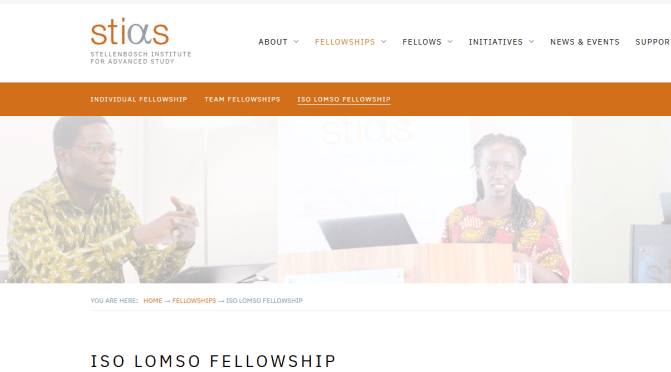
STIAS ISO LOMSO FELLOWSHIP 2026

Application Deadline: 15 February 2026

LOCATION: South Africa

Iso Lomso means ‘the eye of tomorrow’ in isiXhosa: seeing towards the future, laying the foundations for tomorrow. The programme is aimed at African scholars who have obtained a doctoral degree within the preceding seven years and who hold an academic position at a university or research institution anywhere in Africa. Candidates should have established a research programme and have completed a post-doctoral fellowship or equivalent post-PhD programme. All disciplines are considered.

ELIGIBILITY:

To be eligible for the 2026 call, applicants must:

Be a national of any African country;

Be born after the 1st of January 1984;

Have an affiliation at a research or higher education institution in an African country, and continue to do so for the foreseeable future;

Have obtained a doctoral degree from any recognised higher education institution (worldwide) after the 1st of January 2018;

Have completed a post-doctoral fellowship or equivalent post-PhD research programme;

Be in a position to commence a first period of residency at STIAS during 2027.

All disciplines will be considered.  Applicants from non-Anglophone African countries may conduct their research in the language of preference; however, the application documents must be completed in English. Applications will be evaluated and selected on the basis of the following criteria:

Level: the applicant’s academic excellence and the originality and scholarly strength of the proposed research project;

Innovation: the project’s promise of new insights and the potential to produce new knowledge;

Interdisciplinarity: whether the project methodology allows for drawing from different disciplines and its potential to facilitate an interdisciplinary discourse;

Relevance: the project’s relevance for scholarship and knowledge production in Africa;

Feasibility: whether the research design and the research plan are convincing and realistic.

During final selection, additional consideration will be given to: gender representation, diversity of nationalities, diversity of disciplines, participation in previous or current research projects, and previous international experience.

BENEFIT:

STIAS fellow support, which includes:

An economy return flight;

Comfortable accommodation within walking distance from the institute;

Individual offices equipped with a PC, telephone and printer;

A monthly stipend for daily living costs;

Access to the Stellenbosch University library (including electronic resources) and a high-speed internet connection;

Participation in the regular STIAS fellows programme, including daily lunch, weekly fellows’ seminars, STIAS public lectures and social events;

A child care subsidy for fellows accompanied by young children while in residence.

APPLY