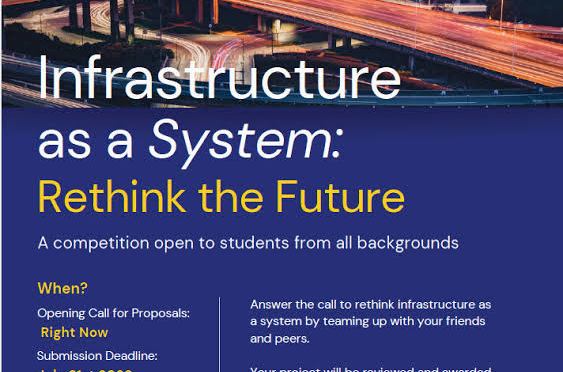
Application Deadline: July 31st, 2026
LOCATION: Multiple Regions
Answer the call: “Infrastructure as a System”, they invite students to rethink infrastructure for a world shaped by climate pressure, technological disruption, regulatory change and shifting demand. Team up with your friends / peers.
ELIGIBILITY:
The contest is open to creative minds from various backgrounds: architecture, urban planning, engineering, complex systems, economics, public policy, computer science, etc.
Participants have to showcase their ideas for designing a fictional infrastructure project that is not just efficient today, but resilient, adaptive, and sustainable across uncertain futures.
The rules are:
Teams can consist of 1 to 6 members
There are no specific requirements related to faculty or disciplinary composition. While multidisciplinary teams are encouraged, it is not mandatory
Team members must have active student status during the academic year 2025-2026
Each team must send at the address contact@infravision-thinktank.com an email with the following details
Names, school and department affiliations, degrees studied, and expected graduation dates of all team members
A concise overview of their project (1-3 sentences are sufficient)
Contact details (email and phone number of the team’s contact person)
What is expected from the teams :
A clear project vision and the value it creates
2 to 3 plausible future scenarios
Key risks, vulnerabilities and adaptation levers
Explicit trade offs between competitiveness, resilience, sustainability and performance
A system perspective connecting the project to wider ecosystems such as mobility, energy or urban planning
A realistic implementation roadmap, budget logic and impact indicator
The submission should go beyond a concept and demonstrate structured thinking:
Project vision and value creation – Define your infrastructure project, its purpose, the problem it addresses, and the value it creates;
Future scenarios – Define 2-3 contrasted and plausible future contexts (e.g., macroeconomic tensions, geopolitical uncertainties, regulatory shock, technological disruption);
Resilience and adaptiveness – Identify key vulnerabilities, risks, and uncertainties. Stress-test and show how your project responds to them (e.g., flexibility, modularity, reversibility);
Trade-offs – Highlight the main tensions (e.g., cost vs. speed, efficiency vs. resilience, performance vs. sustainability). Make your choices explicit and justify them;
Bold bets and quick wins – Propose high-impact ideas, either forward-looking or actionable in the short term. This may include disruptive technologies, policy or regulatory changes, or innovative business and financing models;
Stakeholder engagement – Identify key stakeholders and explain how you will align interests, secure buy-in, and create the right incentives for implementation;
System perspective – Explain how your project interacts with broader systems (e.g., mobility, energy, urban planning) and its role within a wider ecosystem;
Implementation roadmap and budget – Translate your vision into a realistic, phased plan. Specify key milestones, enabling conditions, and budgetary requirement;
Impact assessment – Define the single most important indicator of success. Support your proposal with a high-level cost-benefit perspective and explain what value is created;
The submission should include a 30-40 slides + a written abstract, along with visual representations, sketches, digital or physical models, etc.
BENEFIT:
The competition offers prize money of
7,000 euros for the 1st-placed team,
5,000 euros for the 2nd-placed team, and
3,000 euros for the 3rd-placed team.

 YouthExpat