
Category Archives: competition

SCIENCE & SCILIFELAB PRIZE FOR YOUNG SCIENTISTS

Application Deadline: July 15, 2025

LOCATION: Sweden

The Science & SciLifeLab Prize for Young Scientists was established in 2013. A global prize aimed at rewarding scientists at an early stage of their careers.  The international prize is awarded annually to four young scientists for outstanding life science research based on a doctoral degree earned in the previous two years. 

ELIGIBILITY:

The Prize Categories:

Cell and Molecular Biology: Research in this category includes cellular and molecular processes at levels ranging from single molecule to single cell to tissue and organ systems.

Genomics, Proteomics and Systems Biology Approaches: Research in this category focuses on genomics, proteomics, integrative omics and systems biology approaches, inlcuding computational, to facilitate comprehensive understanding of living cells, organisms and species.

Ecology & Environment: Research in this category encompasses interactions between organisms and their environment, and how these processes are influenced by human activity.

Molecular Medicine: Research in this category aims at building on the molecular understanding of disease in humans to develop preventive, diagnostic and therapeutic approaches, including individualized medicine.

Entrants for the prize must have received their Ph.D. between January 1, 2023 and December 31, 2024. Entrants may only apply once within this time period, and the work described in the entry must have been performed while the entrant was a graduate student. The prize is open to residents of all nations without regard to sex or race.

In addition to completing an online entry form applicants must submit an essay describing their thesis work in one of the qualified categories. The essay cannot exceed 1,000 words in length and may include one figure or table.

Applicants must also submit a one-page reference letter from their advisor or a member of their thesis committee with an assessment of the applicant and comment on the significance of the applicant’s research.

In addition, a list of citations, awards and relevant professional experience should be included, as well as an abstract of the thesis.

The application form can be found at the Science website.

BENEFIT:

The grand prize winner receives $30,000 USD and each of the other three category winners receives $10,000 USD.

In addition, the grand prize winning essay is published in Science magazine and each of the other three winning essays are published at Science online.

Furthermore, all four of the award winners are invited to Sweden for the prize ceremony, held the same week as the Nobel Prize ceremony, attend a scientific symposium to present their work, and be invited to a series of social events in which they are able to network with notable scientific researchers in their fields. Each winner may also bring one guest to the festivities.
APPLY

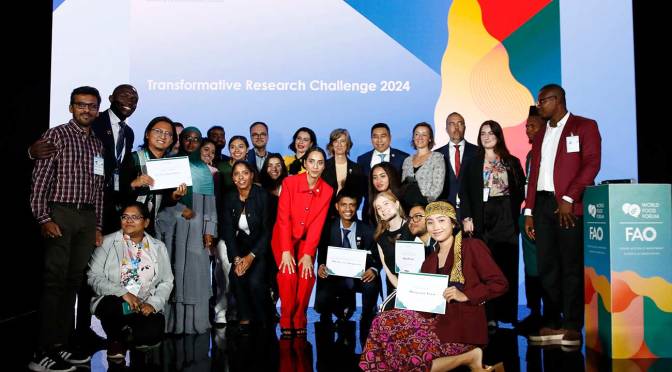
WORLD FOOD FORUM TRANSFORMATIVE RESEARCH CHALLENGE (TRC)

Application Deadline: 9 May 2025 at 24:00 (PDT).

LOCATION:  Italy

The WFF Transformative Research Challenge (TRC) is a global competition designed to empower young researchers to develop innovative and impactful solutions to transform agrifood systems. Since its inception in 2021, the World Food Forum (WFF) Youth Innovation Lab has partnered with leading organizations in agrifood research and United Nations Agencies, including the Food and Agriculture Organization of the United Nations (FAO) to address critical challenges through a global platform.

ELIGIBILITY:

Educational background: All applicants must hold at least a bachelor’s degree in a field related to agrifood systems, which includes but is not limited to areas such as agriculture, food science, environmental science, sustainable development or other related disciplines.

Team composition and age requirements: The competition is open to teams of at least 3 and up to 5 individuals (Entrants). All team members must be between the ages of 18 and 35 at the time of submission of their Concept Note.

FAO employees and their immediate family members (spouses, parents, children, siblings and their respective spouses, regardless of where they live) or persons living in the same households of such employees, whether related or not, are not eligible to enter the competition. WFF Youth Initiative will determine eligibility at its sole discretion. Partners or relatives of partner staff of the institutions involved in the launch of the competition and relations of the judging committee are not eligible to compete.

Originality and copyright: Entrants can only submit original works for which they are the sole creators and copyright holders. In the case of a group of authors, the names and ages of all authors must be listed and will be considered as a single Entrant in the copyright rules described below, as well as for the prizes and benefits indicated in Section 3.

Team composition and member modifications: Entrants may only indicate their team members during the initial submission. Team members cannot be added or removed after the open call for applications closes. The WFF Youth Initiative team retains the right to remain impartial and uninvolved in any disputes concerning changes to team membership.

Supervisor inclusion: Entrants can include a supervisor from their institute/university. This supervisor is not considered part of the team.

Mentor and reviewer restrictions: TRC mentors and reviewers are not permitted to be members of their assigned team and are not permitted to participate as authors of the research submitted by their assigned team.

BENEFIT:

Research funding: Winning teams receive up to USD 10 000 in research funding to implement their research projects. In addition, one team will be selected from the winners of each TRC category as the overall winner of the 2025 Transformative Research Challenge and will be awarded an additional USD 10 000 in research funding.

Global visibility: Finalist teams receive recognition for their innovative work through the WFF website and social media channels, showcasing their projects to a global audience.

Networking opportunities: Finalist teams connect with a global network of young leaders, agrifood experts and representatives from the public and private sectors, including the United Nations.

Capacity development: Semi-finalist teams receive expert guidance to strengthen their skills in research proposal development.

Invitation to FAO headquarters: Finalist teams are invited to present their research at the TRC Finals held at FAO headquarters in Rome in October 2025, in front of a high-level jury and a global audience via live stream on a range of platforms including UN Web TV.

Post awards support: Finalists are invited to apply for the WFF Youth Food Lab incubator programme. Winning teams may also receive continued support to further develop and implement their research proposals.

APPLY