Tag Archives: international competitions

ROYAL SOCIETY OF BIOLOGY PHOTOGRAPHY COMPETITION

Application Deadline: 19 June 2025. 

LOCATION: United Kingdom

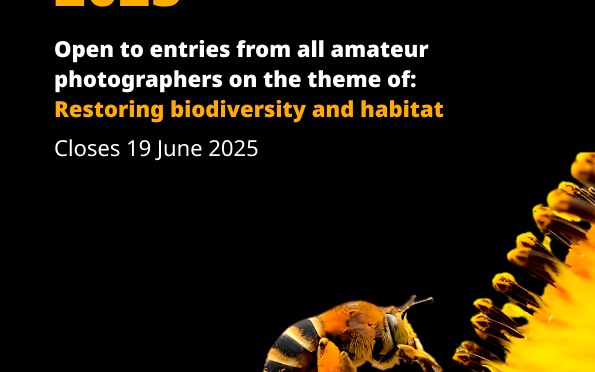
The Royal Society of Biology’s annual photography competition invites amateurs to submit photographs on a particular theme. The theme of the 2025 Photography Competition is Restoring Biodiversity and Habitat.

ELIGIBILITY:

The Organiser of the competition is the Royal Society of Biology, 1 Naoroji Street, London, WC1X 0GB. The competition is open to anyone except those involved in its organisation, employees of the Society and their immediate family, sponsors of the competition, judges and their immediate family.

The competition is free to enter and is open to Society members and nonmembers. Entrants must not be professional photographers. For the purposes of this competition, a professional photographer will be considered to be someone who makes more than half their annual income from photography-related work.

Entrants to the Young Photographer of the Year category must be under 18 years of age at the time of the closing date (19 June 2025).

Entrants under 13 years of age must seek consent from a parent or guardian in order to take part in the competition. Details for the entrant’s parent or guardian will be requested when they submit their photograph(s). The Royal Society of Biology will contact the parent or guardian to confirm details of consent are correct.

Prior to submission, entrants must not have offered any of their entries for sale, been paid for any publication of their entries, or won or been runner-up in any other photographic competition with any of their entries.

At the time of submission, entrants must declare to the Organiser whether they have entered their images in any other photographic competition. Such submissions will be accepted for entry into the RSB Photography Competition at the judges’ discretion.

BENEFIT:

The Photographer of the Year (18 and over) winner’s prize will be £1,000 and the Young Photographer of the Year (under 18) winner’s prize will be £500.
APPLY

UNESCO PRIZE FOR GIRLS’ AND WOMEN’S EDUCATION

Application Deadline: 12 May 2025

LOCATION: France

The UNESCO Prize for Girls’ and Women’s Education honours outstanding and innovative contributions made by individuals, institutions, and organizations to advance girls’ and women’s education

ELIGIBILITY:

Nominations can be made by Governments of UNESCO Member States via their Permanent Delegations to UNESCO, and Non-Governmental Organizations (NGOs) in official partnership with UNESCO. Nominations must focus on an established project or programme designed to advance girls’ and women’s education. Each Permanent Delegation or NGO can make up to three nominations for any edition of the Prize. Self-nominations are not accepted.

The nominations will only be considered if the project/programme:

has a clear focus on advancing girls’ and women’s education, the promotion of gender equality in and through education, and contributes to one or more of the five priority areas of the Prize:

Participation: Supporting girls to transition from primary education to lower-secondary education and to complete full basic education 

Literacy: Supporting adolescent girls and young women to acquire literacy skills

Environment: Supporting the creation of a gender-responsive and safe teaching-learning environment Teachers: Engaging teachers to be change agents with gender-responsive teaching attitudes and practices

Skills: Supporting girls and women to acquire knowledge/skills for life and work

has already been running for at least two years at the time of nomination (for example a project nominated in 2025 must have been active since May 2023); 

shows evidence that it may be replicable, scalable and/or provide significant learning potential for initiatives in other contexts.

Once it has passed the basic eligibility requirements, the project/ programme of the candidate will be assessed by the Jury based on the following three criteria:

Impact: The project/programme’s impact should be qualitatively and/or quantitatively measureable and deliver tangible results relative to the invested resources. This can include demonstrable changes in: attitudes, beliefs and practices in favour of girls’ and women’s education.

girls’ educational participation, attendance, completion and learning outcomes; and/or

removing barriers to girls’ and women’s education, such as gender bias and stereotypes. 

Innovation: The project/programme stimulates, and/or draws on, innovative approaches advancing girls’ and women’s education. This includes new ways of working where “business as usual” has failed, and transformative “out-of  -the-box” thinking and actions. The project/programme can demonstrate innovation in terms of:    

the themes covered;

the methodology employed;

the channels used to create change for girls’  and women’s education; 

the specific knowledge mobilized about gender-related aspects of girls’ and women’s education in order to elaborate innovative solutions; and/or

other aspects, such as tools and products advancing girls’ and women’s education.

BENEFIT:

The Prize is conferred annually to two laureates and consists of an award of US $50,000 each to help further their work in the area of girls’ and women’s education. 

APPLY