Tag Archives: photography

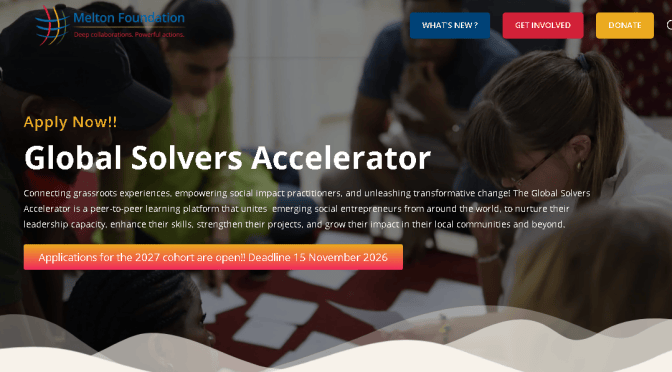
MELTON FOUNDATION GLOBAL SOLVERS ACCELERATION

Application Deadline: 15 November 2026

LOCATION: Germany

Connecting grassroots experiences, empowering social impact practitioners, and unleashing transformative change! The Global Solvers Accelerator is a peer-to-peer learning platform that unites emerging social entrepreneurs from around the world to nurture their leadership capacity, enhance their skills, strengthen their projects, and grow their impact in their local communities and beyond.

ELIGIBILITY:

The Global Solvers Accelerator is for people already working on social, economic, and environmental challenges: grassroots activists, social entrepreneurs and intrapreneurs, SDG practitioners, action researchers, community organizers, and more. What matters isn’t a person’s title; it’s that they’re already running, co-leading, or actively shaping a project, and want to deepen both the work and themselves.

With that in mind, well-suited candidates:

Are between 20 and 35 years old;

Are actively involved in an ongoing project, enterprise, research effort, movement, or community initiative tied to the SDGs—and can influence the decisions within it;

Have a track record of real social impact;

Want to connect globally, advance sustainable development, and help transform society;

Are curious, open-minded, and forward-thinking team players who are at ease working with people from different cultures, backgrounds, and identities—online and in person;

Bring a sharing mindset and a readiness to learn, unlearn, and relearn with peers worldwide;

Have sufficient English language skills to take full part in every aspect of the program;

Can commit roughly 4 hours per week to the program, including online engagement, regular meet-ups, and project-based assignments;

Can attend the week-long Global Solvers Co-Lab (3–10 July 2027, in Germany, fully funded);

Are eager to draw on the Melton Foundation’s global network to strengthen impact and practice global citizenship in local communities.

Beyond the checklist, this program is for people who want to move past showcasing their project and dig into the questions beneath it; who let the process challenge and change them as much as they hope to challenge and change the world around them. It isn’t only about what participants have already achieved; it’s about the mindset they bring: participants show up consistently and authentically, ready to question their own work and to give to the learning community as much as they take from it.

Much of the program is cross-cultural and cross-sector, so it asks for openness, curiosity, and a genuine willingness to learn alongside people from diverse backgrounds, identities, and realities.

BENEFIT:

At the Global Solvers Accelerator, everyone contributes—also financially. The program fee is 900 USD, which you will need to pay only if selected for the program. Scholarships covering 20%, 50%, or 80% of the program fee are available to participants with proven need.

If required, you must request a scholarship as part of your application form.

Melton Senior Fellowship:

Senior Fellow Orientation: December 2027 (Tentative)

Participants who successfully complete the program will be formally inducted into the lifelong Melton Senior Fellowship during this final orientation.

APPLY

SOUTH DAKOTA STATE UNIVERSITY PHD ASSISTANTSHIP – BIGHORN SHEEP POPULATION ECOLOGY AND RESTORATION

Application Deadline: December 19, 2026

LOCATION: USA

The Severud Wildlife Ecology Lab at South Dakota State University (SDSU) is seeking a highly motivated PhD student to study Rocky Mountain bighorn sheep population ecology and restoration in the Greater Badlands ecosystem of South Dakota. The PhD project will focus broadly on the demographic and ecological response of bighorn sheep to population augmentation and recovery. The student will work with GPS/VHF telemetry, population surveys, recruitment monitoring, mortality investigations, GIS data, and existing long-term datasets.

ELIGIBILITY:

Potential research topics include:

Survival and causes of mortality of resident and translocated bighorn sheep

Post-translocation movements, establishment, and integration with resident subherds

Habitat use and factors associated with successful establishment

Reproduction, lamb recruitment, and population growth

Demographic responses to augmentation

Development of monitoring and analytical approaches to inform future augmentation and long-term bighorn sheep management

The project will also include continued disease surveillance and collection of biological samples that may support complementary genetic or other analyses. These activities are important components of the broader restoration program but are not intended to prescribe separate dissertation chapters.

Applicants should have:

An M.S. degree in wildlife ecology, biology, natural resources, or a closely related field by the anticipated start date

Experience conducting wildlife field research

Strong interest in wildlife population ecology, quantitative ecology, and applied conservation

Experience with R and statistical analysis, or demonstrated potential and interest in developing strong quantitative skills

Strong written and oral communication skills

Ability to work independently and collaboratively with a diverse group of project partners

Ability and willingness to conduct fieldwork under challenging conditions

A valid driver’s license

Experience with GPS/VHF telemetry, ungulates, wildlife capture and handling, survival or demographic analysis, GIS/spatial analysis, or population modeling is desirable but not required. Applicants are not expected to have experience in all of these areas.

They are particularly interested in candidates who combine scientific curiosity, quantitative potential, field experience, strong communication skills, and an interest in conducting research that directly informs wildlife conservation and management.

Interested applicants should email a single PDF containing:

A cover letter describing your research interests, relevant experience, and interest in this project
Curriculum vitae
Unofficial undergraduate and graduate transcripts
Contact information for three professional references
In your cover letter, please describe your experience with wildlife field research and quantitative analysis and identify the aspects of this project that most interest you.

Contact: William Severud William.Severud@sdstate.edu (preferred contact method)

BENEFIT:

Salary: starting at $26,400 per year

Experience Required: at least 3 years

Funding and Timing: The anticipated start date is January 2027. The project is being developed as a four-year PhD research and restoration project, with graduate stipend, tuition support, research expenses, field support, and professional travel incorporated into the funding structure. Final funding and administrative agreements are currently being completed.

APPLY